
History is rarely a straightforward narrative of heroes and villains. More often, it is a complex tapestry woven from geopolitical ambitions, secret maneuvers, legal gray areas, and the collision of ideology with constitutional law. Few events in late twentieth-century American history encapsulate this intricate reality quite like the political scandal that rocked the Reagan administration in the mid-1980s.
At its core, this extraordinary chapter involved two seemingly disparate foreign policy crises: an ongoing hostage crisis in Lebanon involving American captives held by Iranian-backed militants, and a fierce ideological battle in Central America where Marxist revolutionaries in Nicaragua were opposed by U.S.-backed insurgent forces. Behind closed doors, senior officials in Washington devised a covert, highly unorthodox plan to link these two theaters, bypassing congressional oversight, violating arms embargoes, and pushing the boundaries of executive power to their absolute limits.
The Geopolitical Landscape of the 1980s
To understand how a clandestine network of national security officials managed to orchestrate one of the most controversial political scandals in modern history, one must first examine the global chessboard of the Cold War. The 1980s were marked by intense ideological competition between the United States and the Soviet Union. Every regional conflict, from the horn of Africa to the jungles of Central America and the oil-rich plains of the Middle East, was viewed through the lens of this overarching superpower rivalry.
Nicaragua and the Sandinista Threat
In 1979, a leftist guerrilla movement known as the Sandinista National Liberation Front (FSLN) successfully overthrew the authoritarian regime of Anastasio Somoza Debayle in Nicaragua. Initially, the United States attempted to maintain diplomatic relations and even provided modest economic aid. However, as the Sandinistas consolidated power, aligned themselves closely with Cuba and the Soviet Union, and began supporting leftist insurgencies in neighboring El Salvador, the administration of President Ronald Reagan shifted to a policy of outright hostility.
The White House viewed Nicaragua as a dangerous communist beachhead on the American mainland. To counter the Sandinistas, the Central Intelligence Agency (CIA) began organizing, training, and financing a counter-revolutionary military force known as the Contras.
The Legislative Pushback: The Boland Amendments
As reports of human rights abuses by the Contras mounted and public skepticism regarding U.S. involvement in Central America grew, the United States Congress began to push back against the administration’s aggressive interventionist policies.
Between 1982 and 1984, Congress passed a series of legislative restrictions known collectively as the Boland Amendments. These acts strictly prohibited intelligence agencies, including the CIA and the Department of Defense, from providing military aid, equipment, or advice to the Contras to overthrow the Nicaraguan government. For an administration deeply committed to rolling back Soviet influence in the Western Hemisphere, these restrictions were seen not as a constitutional check, but as a legislative roadblock that threatened national security.
The Middle East Crisis: Iran, Iraq, and Hostages
Simultaneously, the Middle East was engulfed in turmoil. The Iranian Revolution of 1979 had replaced a pro-Western monarchy with an anti-American Islamic republic led by Ayatollah Ruhollah Khomeini. By 1980, neighboring Iraq, led by Saddam Hussein, invaded Iran, sparking a brutal, eight-year war of attrition.
The United States maintained an official policy of strict neutrality, accompanied by an arms embargo—known as Operation Staunch—designed to prevent nations from selling weapons and military spare parts to Iran.
However, a parallel humanitarian crisis was unfolding in war-torn Lebanon. A militant group affiliated with Hezbollah, operating under Iranian influence, began kidnapping Western citizens, including American diplomats, journalists, and educators. These hostages were held in agonizing conditions, and their plight became a dominant media obsession in the United States, exerting immense political pressure on the Reagan administration to secure their release.
The Genesis of the Scheme: Arms for Hostages
Faced with the strict prohibition against negotiating with terrorists and the official arms embargo against Iran, a small faction within the National Security Council (NSC) began exploring covert channels. The central premise was disarmingly simple in theory, yet explosive in practice: sell American anti-tank and anti-aircraft missile parts to moderate elements within the Iranian military in exchange for Iranian pressure on Hezbollah to release American hostages.
Key Players in the Executive Branch
The operation was largely hatched and executed within the confines of the White House basement by individuals who believed they were acting in the highest national interest, even if it meant circumventing established laws:
- Robert McFarlane: National Security Advisor who initiated early diplomatic contacts with Iranian intermediaries.
- Rear Admiral John Poindexter: McFarlane’s successor as National Security Advisor, who oversaw the day-to-day coordination of the secret operations.
- Lieutenant Colonel Oliver North: A charismatic and energetic marine officer assigned to the NSC staff, who served as the operational mastermind, managing logistics, Swiss bank accounts, and private intermediaries.
- William Casey: Director of Central Intelligence, who provided intelligence support, operational guidance, and institutional cover.
The Mechanism of the Arms Sales
To execute the weapons transfers without alerting the State Department, Congress, or the broader defense establishment, the administration utilized a complex web of private arms dealers, international brokers, and front companies. Figures such as Saudi billionaire arms dealer Adnan Khashoggi, Iranian middleman Manucher Ghorbanifar, and retired Air Force Major General Richard Secord played crucial roles in facilitating the transactions.
The weapons were shipped from U.S. military stockpiles, routed through Israel, and delivered to Iran. In return, exorbitant markups were charged to the Iranian buyers. While a portion of the funds reimbursed the U.S. government for the baseline cost of the weaponry, a massive financial surplus accumulated in secret Swiss bank accounts controlled by Secord and North.
Diverting the Funds: The Contra Connection
Had the operation been strictly limited to selling weapons to Iran in a misguided attempt to free hostages, it would have already violated U.S. foreign policy and international norms. However, what transformed a rogue diplomatic initiative into a full-scale constitutional crisis was the decision to redirect the profits from the Iranian arms sales to fund the Nicaraguan Contras, directly bypassing the congressional bans imposed by the Boland Amendments.
The Financial Network
Lieutenant Colonel Oliver North, working alongside Richard Secord and business partner Albert Hakim, established a private, self-sustaining covert infrastructure often referred to as “The Enterprise.” This private organization operated outside official government channels, maintaining its own fleet of cargo planes, pilots, bank accounts, and communication systems.
Money generated from the inflated arms sales to Iran was funneled through these private accounts. From there, funds were transferred to the Contras to purchase rifles, ammunition, uniforms, and logistical support. In the minds of the conspirators, they had created an ingenious workaround to keep the Nicaraguan resistance alive despite congressional interference. In the eyes of the law, however, they were violating federal statutes and usurping Congress’s exclusive power of the purse.
The Scandal Breaks: From Whisper to Headline
For more than a year, the intricate network of secret arms shipments and illegal fund transfers operated in the shadows. But the complex web of deception was inherently unstable.
The Al-Shiraa Leak
The first crack in the facade appeared in November 1986. A pro-Syrian Lebanese magazine, Al-Shiraa, published an exposé detailing the secret visit of former National Security Advisor Robert McFarlane to Tehran, carrying a Bible, a cake, and military spare parts. The revelation stunned the international community and contradicted years of official U.S. denials that the government was negotiating with the Iranian regime.
The Attorney General’s Press Conference
As investigative journalists and congressional committees began demanding answers, Attorney General Edwin Meese III conducted an internal review of the NSC documents. On November 25, 1986, Meese held a dramatic press conference at the White House, publicly revealing that profits from the Iranian arms sales had indeed been diverted to the Contras—and that the President of the United States had been kept in the dark about the financial diversion.
Investigations, Hearings, and Constitutional Fallout
The revelation ignited an immediate firestorm in Washington. Both the House of Representatives and the Senate established select committees to investigate the matter, leading to some of the most dramatic televised congressional hearings in American history.
The Tower Commission
Before the congressional hearings commenced, President Reagan appointed a bipartisan review board chaired by former Senator John Tower to investigate the role of the National Security Council. The Tower Commission Report, released in February 1987, was deeply critical of the administration’s management style, accusing Reagan of running a “turtles-all-the-way-down” management structure that lacked oversight and allowed enthusiastic subordinates to pursue policies without accountability.
The Televised Hearings of 1987
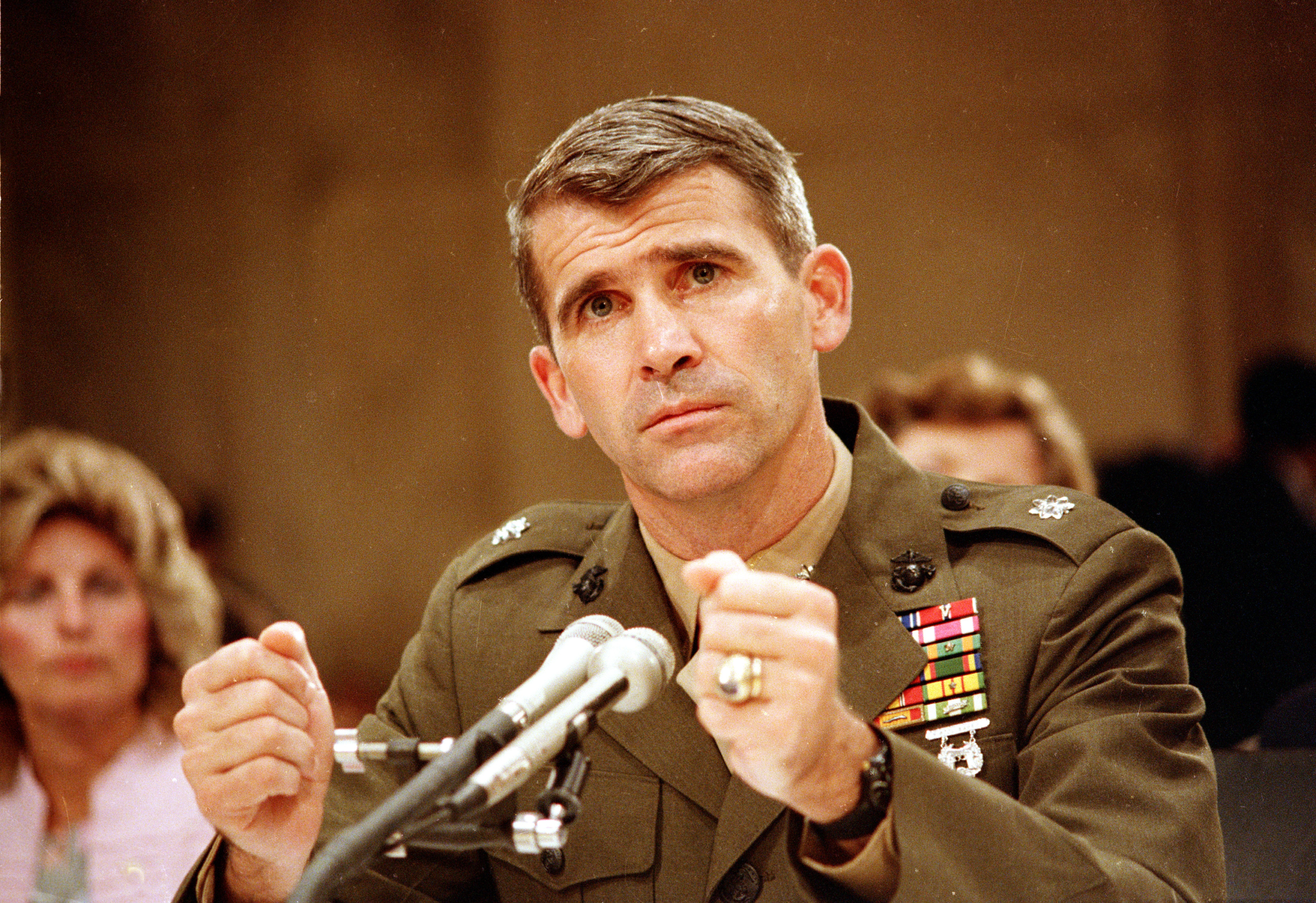
During the summer of 1987, the joint congressional committees held televised hearings that riveted the American public. Witness after witness took the stand, but none captured the public imagination quite like Lieutenant Colonel Oliver North.
Dressed in his full Marine Corps uniform adorned with medals, North defended his actions with fierce patriotism, arguing that he had lied to Congress and shredded documents out of loyalty to his country and to protect national security. His testimony polarized the nation: to his critics, he was a self-confessed lawbreaker who subverted democracy; to his supporters, he was a patriotic soldier hung out to dry by timid politicians.
| Key Figure | Official Title | Role in the Scandal | Legal Outcome / Consequence |
| Ronald Reagan | President of the United States | Authorized arms-for-hostages policy; claimed ignorance of fund diversion. | No criminal charges; political damage and legacy tarnished. |
| George H.W. Bush | Vice President of the United States | Attended key meetings; maintained peripheral involvement and denied prior knowledge. | Elected President in 1988; later issued controversial pardons in 1992. |
| Oliver North | NSC Staff Member | Operational mastermind; managed arms sales, bank accounts, and document shredding. | Convicted of obstructing Congress, destroying documents, and accepting an illegal gratuity; convictions later overturned on technicalities. |
| John Poindexter | National Security Advisor | Oversaw NSC operations; authorized North’s actions; shielded Reagan. | Convicted of multiple felony counts of conspiracy and misleading Congress; convictions overturned on appeal due to use of immunized testimony. |
| Caspar Weinberger | Secretary of Defense | Opposed the arms sales privately; testified about notes he kept. | Indicted for perjury, but received a presidential pardon from George H.W. Bush before trial. |
| Robert McFarlane | National Security Advisor | Initiated early contacts with Iranian intermediaries. | Pleaded guilty to withholding information from Congress; received probation and a pardon. |
The Legal Aftermath and Special Prosecutor Investigation
Following the congressional hearings, Independent Counsel Lawrence Walsh was appointed to conduct a comprehensive criminal investigation into the affair. Walsh’s probe lasted over six years and resulted in multiple indictments and convictions of high-ranking administration officials.
However, many of the convictions secured by the Independent Counsel were later overturned on appeal. The appellate courts ruled that witnesses who had testified before Congress under a grant of legislative immunity could not have their testimony used against them in subsequent criminal prosecutions—a legal hurdle that complicated Walsh’s efforts.
In December 1992, outgoing President George H.W. Bush—who had served as Vice President during the scandal—issued pardons to six former officials involved in the affair, including former Secretary of Defense Caspar Weinberger and former National Security Advisor McFarlane, effectively bringing the protracted legal chapter to a close.
Historical Impact and Enduring Legacy
The events of the mid-1980s left an indelible mark on American political culture, constitutional law, and foreign policy practice.
The Balance of Powers
The scandal forced a profound re-examination of the distribution of power between the executive branch and the legislative branch regarding foreign policy and covert operations. It underscored the vital importance of the oversight mechanisms established by the National Security Act of 1947 and reaffirmed that executive agencies cannot legally bypass congressional mandates through private networks or foreign intermediaries.
Public Trust and Executive Transparency
For the American public, the affair eroded institutional trust, demonstrating how secrecy within the highest echelons of government can lead to deep constitutional crises. It highlighted the dangers of ideological zealotry overpowering adherence to domestic and international law.
Ultimately, the complex episode stands as a cautionary tale in modern statecraft—a reminder that the methods used to defend a nation must remain anchored within the rule of law, constitutional checks, and public accountability.
