
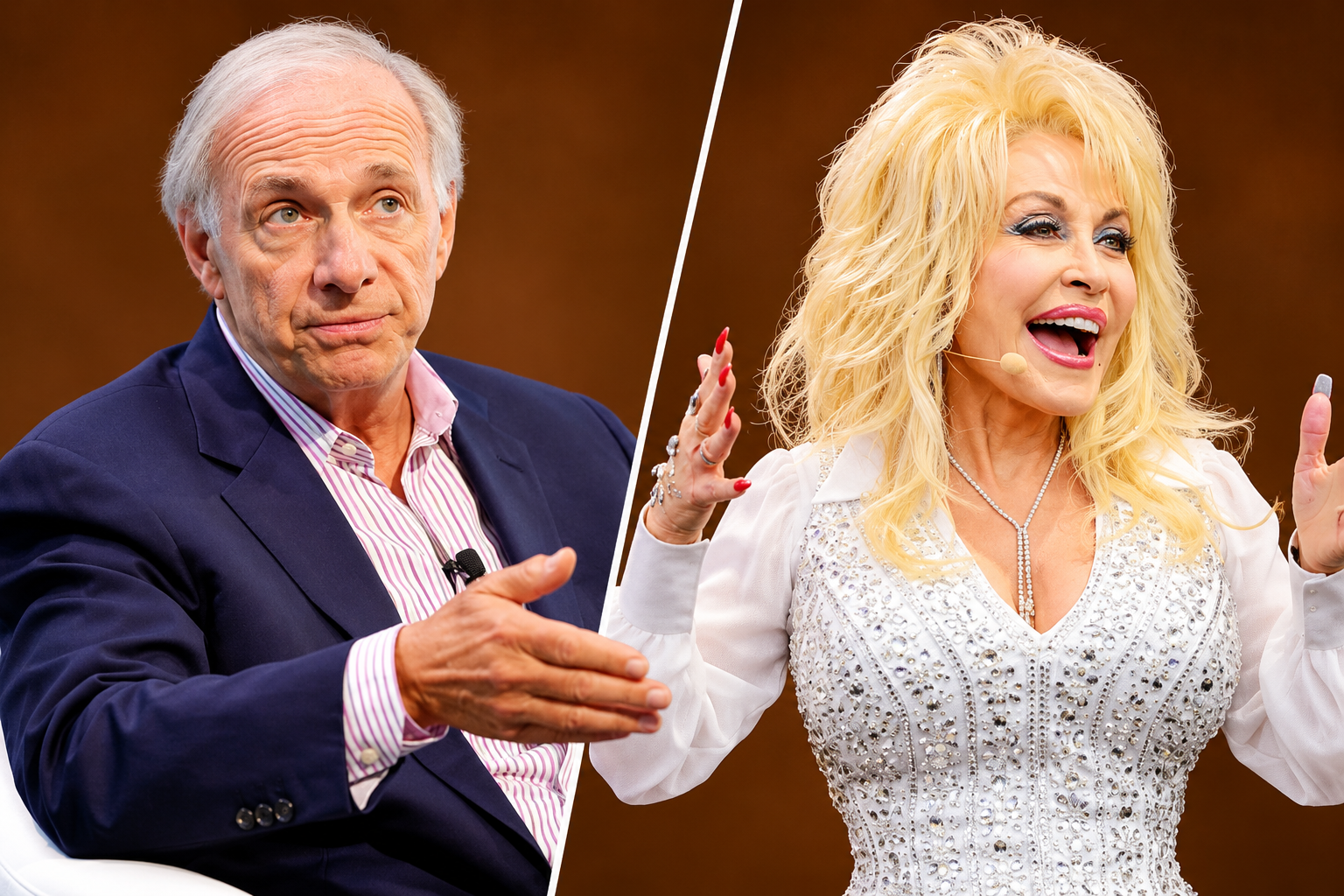

When you look across the vast landscape of global culture, certain figures stand out not just for what they have achieved, but for the distinct operational blueprints they leave behind. If you were to draw a Venn diagram of modern icons, placing a Wall Street billionaire hedge fund titan on one side and a legendary queen of country music on the other, you might expect very little overlap.
On one side sits Ray Dalio, the mastermind behind Bridgewater Associates, a man who views the world through the cold, calculated lens of macroeconomics, algorithms, and radical truth. On the other side stands Dolly Parton, a shimmering beacon of Appalachian warmth, self-made musical royalty, and emotional intelligence, whose smile is as famous as her songwriting catalog.
Yet, despite inhabiting seemingly disparate universes, Ray Dalio and Dolly Parton share an uncanny alignment in how they achieved mastery, navigated immense adversity, and built enduring empires. Both rose from ordinary or challenging beginnings to construct definitions of success entirely on their own terms. By examining their contrasting yet complementary philosophies, we uncover a masterclass in resilience, systematic thinking, authenticity, and legacy.
Part 1: The Architecture of Reality – Ray Dalio’s Systematic Mind
To understand Ray Dalio’s approach to life, one must understand his obsession with reality. Dalio did not reach the pinnacle of global finance by accident; he built a philosophy rooted in the acceptance of truth—however uncomfortable that truth might be.
From Long Island to Global Markets
Growing up in a middle-class family in Queens, New York, Dalio began caddying at golf courses as a young boy, where he encountered Wall Street professionals who introduced him to the stock market. By the time he was twelve, he bought shares of Northeast Airlines, driven purely by the fact that the stock was cheap and set up for a potential merger. When the airline was bought out, his investment tripled. He was hooked.
However, Dalio’s path was far from linear. In the late 1980s, after a monumental miscalculation regarding the trajectory of the global economy, he lost vast sums of money, forcing him to lay off nearly everyone at Bridgewater Associates. He was reduced to borrowing money from his father to pay his family’s grocery bills.
Instead of retreating, Dalio treated this catastrophic failure as a vital data point. He realized that pain plus reflection equals progress. This realization birthed his core operating philosophy: treating life, business, and markets like a giant machine governed by cause-and-effect relationships.
The Power of Radical Transparency
Dalio’s institutional framework at Bridgewater relies on two pillars that sound jarring in traditional corporate environments:
- Radical Truth: Creating an environment where people are encouraged to voice disagreements and look objectively at flaws without ego getting in the way.
- Radical Transparency: Recording meetings, sharing data openly, and eliminating corporate politics to ensure the best ideas win, regardless of hierarchy.
For Dalio, success is not about being right; it is about figuring out how to be right by stress-testing assumptions against reality. He codified these beliefs in his seminal work, Principles, turning his personal failures into an open-source manual for decision-making.
Part 2: The Heart of Connection – Dolly Parton’s Cultural Empire
While Ray Dalio was mapping out macroeconomic debt cycles and algorithmic investment rules, Dolly Parton was composing a masterclass in emotional resonance, branding, and strategic business acumen from the front porch of a one-room cabin in Locust Ridge, Tennessee.
The Girl from Sevierville
Dolly Rebecca Parton grew up the fourth of twelve children in a struggling Appalachian family. Money was scarce, but music and storytelling were abundant. Her grandfather was a Pentecostal preacher, and her mother filled their home with traditional mountain folk songs.
Dolly knew early on that her voice was her ticket to a wider world. Armed with a homemade guitar and an unwavering sense of self, she moved to Nashville the very day she graduated high school in 1964. Early struggles did not deter her; whether she was navigating the male-dominated country music scene of the late 1960s or breaking out as a crossover pop sensation, Dolly maintained absolute control over her creative output.
The Business Genius Behind the Rhinestones
One of the greatest misconceptions about Dolly Parton is that she is merely a talented entertainer. In reality, she is a corporate powerhouse. When asked about her flamboyant appearance, she famously quipped, “It costs a lot of money to look this cheap.” This self-aware humor masks a razor-sharp business mind.
In the 1980s, she made a bold move by purchasing her own publishing rights through her company, Velvet Apple Music, ensuring that she owned the copyright to iconic tracks like “I Will Always Love You” (which Elvis Presley later wanted to buy half of; Dolly famously declined, a decision that generated millions when Whitney Houston covered it decades later).
Furthermore, she built Dollywood, a massive theme park in Pigeon Forge, Tennessee, which revitalized the local economy of her home region, employing thousands of people and drawing millions of visitors annually. Dolly understood branding decades before modern social media influencers coined the term. She created a caricature of herself that was so approachable, warm, and disarming that people trusted her implicitly, allowing her to build an empire spanning film, television, music, and philanthropy.
Part 3: Comparing the Titans – A Framework for Success
To truly understand how these two legends intersect in their pursuit of excellence, we can break down their operational strategies across core life dimensions.
| Dimension | Ray Dalio’s Approach | Dolly Parton’s Approach |
| Core Philosophy | Treat life like a machine; master economic and operational systems through data and logic. | Treat life like a song; navigate challenges through emotional intelligence, storytelling, and human connection. |
| Handling Failure | “Pain + Reflection = Progress.” Systematically analyze mistakes to build algorithmic defenses. | “The way I see it, if you want the rainbow, you gotta put up with the rain.” Lean into faith, humor, and resilience. |
| Authenticity | Radical Transparency—saying exactly what is on your mind regardless of social friction. | Radical Self-Acceptance—owning your identity so completely that critics lose their power over you. |
| Scaling Success | Institutionalizing principles, codifying metrics, and creating meritocratic corporate systems. | Building tangible cultural touchstones (Dollywood, massive song catalogs) and community-driven initiatives. |
| Legacy & Giving | Systematic philanthropy focused on ocean exploration, education, and economic research. | Grassroots philanthropy (Imagination Library) focused on childhood literacy and regional economic uplift. |
Part 4: Radical Authenticity as the Ultimate Superpower
At first glance, a cold analytical investor and a warm poetic songwriter seem to occupy opposite poles of human expression. Yet, both Dalio and Parton achieved total mastery because they mastered authenticity.
Most people spend their lives wearing masks, terrified of what others might think. They curate their behavior to fit societal molds, which introduces friction, drains energy, and leads to poor decision-making. Dalio and Parton solved this problem in two radically different ways, arriving at the exact same destination of unshakeable confidence.
Dalio’s Elimination of Ego
Ray Dalio identified the ego as the single greatest barrier to learning. In his view, the “subconscious ego” is the defensive mechanism that makes people hate being wrong, even when being wrong stands between them and the truth. By creating a culture of radical transparency at Bridgewater, Dalio forced himself and his employees to strip away ego. When someone proves Dalio wrong, he does not get defensive; he updates his mental model. This detachment from personal pride allowed him to navigate complex global financial shifts that broke other investors.
Dolly’s Embrace of Self-Caricature
Dolly Parton took the opposite psychological route, yet achieved the same ego-free liberation. Early in her career, Nashville executives urged her to tone down her makeup, wear simpler clothes, and adopt a more conventional look to be taken seriously as a serious musician. Dolly refused. Instead, she leaned heavily into an exaggerated, hyper-feminine persona inspired by the town tramp she remembered from her youth.
By owning her look entirely, Dolly weaponized self-awareness. Critics could never insult her because she had already insulted herself first, laughing along with the audience. Beneath the heavy wigs, acrylic nails, and sparkling outfits lay a disciplined, iron-willed businesswoman who never lost sight of who she was. By refusing to conform to industry standards, she set them.
Part 5: The Economics of Generosity and Legacy
True greatness is rarely measured solely by how much wealth an individual accumulates; it is measured by what they do with that influence once the peak has been reached. Both Dalio and Parton have transitioned heavily into legacy-building, proving that extreme success carries a corresponding duty to uplift others.
Ray Dalio’s Systematic Philanthropy
Through Dalio Philanthropies, Ray and his family have funneled billions into causes ranging from ocean exploration (via OceanX, a state-of-the-art marine research vessel) to public education reform and financial health research. Dalio views philanthropy not merely as an emotional reaction to suffering, but as an allocation problem that requires systemic engineering. He wants to understand why societal machinery breaks down and how to design scalable interventions that fix root causes rather than temporary symptoms.
Dolly Parton’s Grassroots Impact
Dolly’s philanthropic footprint is equally staggering, though entirely grassroots in flavor. In 1995, she launched the Imagination Library, an initiative inspired by her father’s inability to read. The program mails a free book every month to children from birth until they enter school, scaling from a local Tennessee project into a global phenomenon that has shipped hundreds of millions of books worldwide.
When disasters strike—such as the devastating Gatlinburg wildfires in 2016 or catastrophic floods in East Tennessee—Dolly immediately steps in with millions of dollars from her personal foundation to support displaced families, ensuring that her success directly cushions the community that raised her.
Part 6: Integrating the Dalio-Parton Blueprint into Daily Life
While writing code for a hedge fund and writing three-part harmony country songs require vastly different toolsets, merging the core mental models of Ray Dalio and Dolly Parton offers a surprisingly practical blueprint for anyone trying to navigate modern life, career building, or creative entrepreneurship.
1. Build Systems, But Honor Your Intuition
Dalio teaches us that processes beat erratic bursts of effort. By setting up predictable routines, analyzing mistakes objectively, and tracking metrics, we remove emotional fatigue from decision-making. However, as Dolly reminds us, life is not purely a spreadsheet. Emotional intelligence, empathy, and creative spark breathe life into cold systems. The sweet spot of high performance lies at the intersection of rigorous discipline and heartfelt passion.
2. Strip Away the Need for Approval
Whether through Dalio’s insistence on radical truth or Dolly’s fearless ownership of her unique identity, both icons teach us that pleasing everyone is a recipe for mediocrity. When you stop protecting your ego, you open the door to rapid learning and uncompromising originality.
3. View Setbacks as Raw Material
Dalio went broke in his late twenties; Dolly grew up sharing a bed with multiple siblings in a home with no electricity or running water. Both faced profound moments where quitting would have been the easy choice. Instead, they weaponized their struggles, turning hardship into the foundational fuel for their subsequent empires.
Conclusion
Ray Dalio and Dolly Parton may never share a stage or co-author a financial treatise, but they stand as towering twin pillars of what human potential looks like when pushed to its absolute limits. One approached the world with a calculator, charting the invisible macroeconomic tides that move nations. The other approached the world with a guitar, charting the universal emotional chords that connect human hearts.
By studying both figures, we realize that true mastery does not require coldness or conformity. It requires a fierce commitment to reality, an absolute refusal to let ego dictate our choices, and an enduring dedication to leaving the world better, smarter, and brighter than we found it.
